


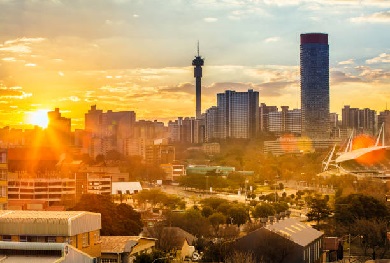
Johannesburg cityscape, taken at sunset, showing Hillbrow residential centre with the prominent Ponte flats and the communications tower.
Historically, businesses in Steve Tshwete benefited from electricity tariffs that were often lower than those paid by businesses in Johannesburg, thereby reinforcing the municipality’s competitiveness as an industrial location. This is no longer the case.
Johannesburg Municipality’s 2026/27 electricity tariff increase prioritises industry impact while adhering to the NERSA framework. The applicable increase was approximately 9.01%. Johannesburg emphasised that business and industrial customers should remain competitive and that tariff structures should avoid placing excessive pressure on economic activity and investment.
This aligns with City Power’s longstanding approach, which recognises business customers as critical contributors to municipal revenue and economic growth. In previous tariff consultations, the City noted that business customers contribute disproportionately to turnover and therefore that increases should be managed carefully.
STLM historically enjoyed a reputation as a competitive location for energy-intensive industry. Any electricity-cost advantage that may have existed has narrowed significantly. By 2026, STLM’s approved electricity tariff increase (11.7%) exceeds Johannesburg’s average increase (8.63%-9.01%).
Steve Tshwete can no longer rely on cheaper electricity as a competitive advantage. Steve Tshwete’s electricity increase was approximately 36% higher than Johannesburg’s increase (11.7% versus 8.63%).
Johannesburg’s approach is noteworthy because it demonstrates that a municipality can:
- Avoid passing the full Eskom increase directly to customers.
- Use tariff structuring to cushion economic impacts.
- Explicitly consider the competitiveness of business and industrial customers when setting tariffs.
Steve Tshwete
- Implemented a Cost of Supply-based tariff approved by NERSA.
- Electricity remained the highest tariff increase among all municipal services.
- Reduced increases for rates, water and refuse, but not for electricity.
This means electricity cost escalation for businesses in Steve Tshwete is significantly higher than in Johannesburg, putting pressure on manufacturers, mines, and commercial enterprises operating in the municipality.
MCCI urges the municipality’s decision-makers to rebuild the relationship we had in the first two decades of this century, where our town grew in strength. Currently, it appears that some of the executive officials see the broader business community as an unimportant role player in the town’s economy.